


Difference Between Threaded Layflat Pipe and Polyethylene Irrigation Pipe

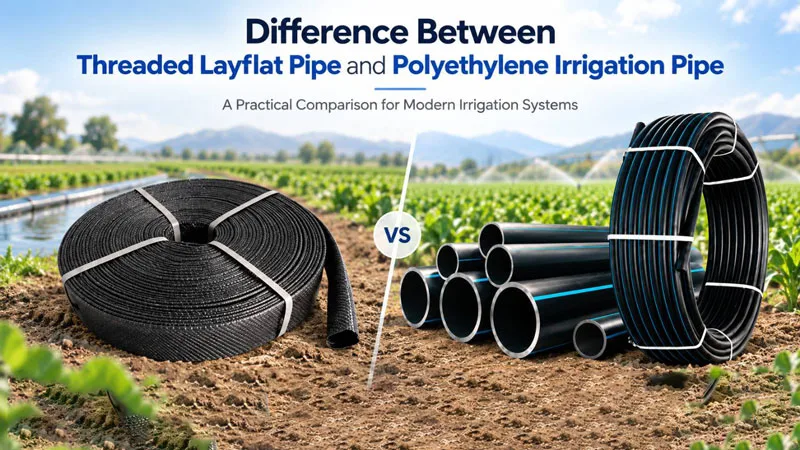
Difference Between Threaded Layflat Pipe and Polyethylene Irrigation Pipe
Which One Is Better for Irrigation Systems?
In agricultural irrigation systems, choosing the right type of pipe plays a very important role in water transfer quality, system durability, installation cost, and ease of use. Two commonly used products in this field are threaded agricultural pipe and polyethylene irrigation pipe. Both are used for water transfer, but they differ significantly in structure, application, working pressure, durability, and installation method.
If you are planning to buy irrigation equipment for a farm, greenhouse, orchard, or agricultural land, understanding the difference between these two products will help you make a more accurate and cost-effective choice.
What Is Threaded Agricultural Pipe?
Threaded agricultural pipe, also known in the market as threaded layflat pipe, threaded irrigation pipe, or flat threaded agricultural hose, is a flexible and rollable pipe used for water transfer in agricultural applications.
This pipe usually has a reinforced layer made with thread or fibers. This reinforcement helps the pipe resist pressure, stretching, and tearing. When the threaded pipe is empty, it becomes flat and easy to roll. When water flows through it, it expands and works as a water transfer pipe.
Applications in Irrigation
Threaded pipe is mostly used in systems that require fast installation, easy movement, and collection at the end of the season. Its most important applications include:
- Water transfer from pump, well, pool, or water source to agricultural land
- Use in rented lands or seasonal cultivation
- Irrigation of vegetables and row crops
- Connection to drip tape in drip irrigation systems
- Water transfer in temporary surface lines
- Use in projects that require a lightweight and portable pipe
Example: For a farmer growing tomatoes, cucumbers, watermelons, or vegetables in a seasonal field, a product that can be quickly collected after the season ends is needed. In this situation, threaded layflat pipe is a practical and economical option.
What Is Polyethylene Irrigation Pipe?
Polyethylene irrigation pipe is one of the most common and standard pipes used for water transfer in agricultural systems. This pipe is usually made from polyethylene material and is available in different sizes and pressure ratings.
Unlike threaded layflat pipe, polyethylene pipe has a round, strong, and more fixed structure. It is used for main lines, sub-main lines, and lateral lines in irrigation systems, and it is widely used in fixed and long-term projects.
Applications in Irrigation
Polyethylene pipe is widely used in professional and permanent irrigation systems. Its most important applications include:
- Main water transfer line from pump to farm
- Sub-main line for distributing water to different field sections
- Manifold for drip tape systems
- Orchard and tree irrigation
- Greenhouse irrigation
- Drip irrigation, sprinkler irrigation, and pressurized systems
- Underground or fixed water transfer lines
Standard System Layout
In many irrigation projects, the standard system layout is:
Main Difference Between Threaded Pipe and Polyethylene Pipe
The most important difference between these two products is their application. Threaded pipe is mostly used for temporary and seasonal water transfer, while polyethylene pipe is more suitable for fixed, permanent, and pressurized irrigation systems.
Threaded pipe is lighter, more flexible, and easier to collect. Polyethylene pipe, on the other hand, is more durable, has higher pressure resistance, and is more suitable for the main and permanent lines of an irrigation system.
Comparison Table
| Feature | Threaded / Layflat Pipe | Polyethylene Irrigation Pipe |
|---|---|---|
| Appearance | Flat when empty, expands with water | Round, strong, and fixed |
| Flexibility | Very high | Medium |
| Collection after use | Very easy | More difficult |
| Weight | Lighter | Heavier |
| Durability | Suitable for seasonal use | Suitable for long-term use |
| Pressure resistance | Usually lower | Higher |
| Installation | Fast and easy | More technical and professional |
| Main application | Temporary and seasonal water transfer | Main, sub-main, and fixed lines |
| Suitable for underground installation | Usually no | Yes |
| Suitable for rented land | Very suitable | Less suitable |
| Suitable for permanent projects | Less suitable | Very suitable |
| Fittings | Special layflat fittings | Polyethylene fittings, clamps, valves |
Who Should Use Threaded Pipe?
Threaded pipe is suitable for farmers who need a lightweight, fast, and easy-to-collect water transfer system. This product is especially useful for seasonal cultivation and lands that change every year.
If the agricultural land is rented, the water transfer path is not permanent, or the farmer wants to collect the pipes after the season, threaded pipe can be the better choice.
Suitable For:
- Vegetable farming & Green crops
- Row crops & Seasonal fields
- Rented agricultural lands
- Water transfer from pool or pump to the field
- Connection to drip tape in temporary systems
- Farmers who need easy transportation and handling
Who Should Use Polyethylene Pipe?
Polyethylene pipe is suitable for people who want to install a fixed and long-term irrigation system. Because of its high resistance, different pressure ratings, and ability to be buried underground, it is a more reliable choice for professional projects.
If the irrigation system is planned to be used for several years, the pipe route is fixed, or the pump pressure is high, polyethylene pipe is the better option.
Suitable For:
- Main irrigation lines
- Sub-main and lateral lines
- Orchards & Greenhouses
- Permanent drip irrigation systems
- Sprinkler irrigation systems
- Fixed agricultural projects
- Underground water transfer lines
- Near-pump and pressurized routes
Detailed Technical Differences
Difference in Installation and Execution
One of the key differences between threaded pipe and polyethylene pipe is the installation method. Threaded pipe can be easily laid on the ground and connected to pumps, valves, or drip tapes using special fittings. Its installation is fast and does not require heavy equipment or high technical skill.
Polyethylene pipe, however, requires proper fittings, clamps, reducers, tees, valves, and sometimes polyethylene welding equipment for professional installation. Its installation is more technical, but it provides better durability and stability.
Difference in Working Pressure
Polyethylene pipes are usually produced in different working pressures such as 4 bar, 6 bar, 10 bar, and even higher. That is why they are more reliable for areas near the pump, main lines, and pressurized systems.
Threaded pipes are generally used for lower-pressure agricultural water transfer. Of course, product quality, thickness, and reinforcement type affect its pressure resistance, but in general, for higher pressure applications, polyethylene pipe is the better choice.
Difference in Collection and Transportation
Threaded pipe has a clear advantage in this area. After the water is drained, it becomes flat and can be easily rolled. This feature makes it very useful for farmers who collect their irrigation equipment at the end of the season.
Polyethylene pipe is harder to collect because of its round and thicker structure. Especially in larger sizes, moving and installing it requires more labor and more space.
Difference in Price and Economic Value
From an economic point of view, the choice between threaded pipe and polyethylene pipe depends on the type of project. For temporary and seasonal projects, threaded pipe is usually more economical because it has fast installation, easy handling, and lower installation cost.
For fixed and long-term projects, polyethylene pipe may have a higher initial cost, but because of its longer durability and longer service life, it is more cost-effective in the long run.
Which One Is Better for Drip Irrigation?
In drip irrigation, both types of pipes can be used, but their roles are different.
Polyethylene pipe is usually used for the main line, sub-main line, or drip tape manifold. In this system, water enters the polyethylene pipe from the pump and is then distributed to the drip tapes.
Threaded pipe can also be used as a temporary water transfer line or seasonal manifold. In this case, drip tapes are connected to the threaded pipe using special fittings.
For seasonal crops such as tomatoes, cucumbers, watermelons, melons, onions, and vegetables, the combination of threaded pipe + drip tape is very practical. But for greenhouses, orchards, and permanent systems, the combination of polyethylene pipe + emitters or drip tape is more professional.
For Drip Tape, Is Threaded Pipe Better or Polyethylene Pipe?
If the goal is to install a temporary, lightweight, and easy-to-collect system, threaded pipe is a suitable choice. In this case, the farmer can place the threaded pipe at the beginning of the rows and connect the drip tapes to it.
But if the system is intended to be fixed and used for several seasons or years, it is better to use polyethylene pipe as the manifold. Polyethylene pipe has higher resistance and is more suitable for permanent installation.
Advantages Summary
Advantages of Threaded Pipe
- Fast and easy installation
- Easy collection after the season
- Lightweight and easy to carry
- Suitable for seasonal and rented lands
- Connectable to drip tape with special fittings
- Suitable for temporary water transfer routes
- Economical for seasonal cultivation
- High flexibility
Advantages of Polyethylene Pipe
- High durability
- Higher pressure resistance
- Suitable for main and sub-main lines
- Usable in permanent irrigation systems
- Can be buried underground
- Suitable for farms, greenhouses, and orchards
- Compatible with different polyethylene fittings
- Long service life & Good resistance to environmental conditions
What Should You Consider Before Buying?
Before choosing between threaded pipe and polyethylene pipe, several important points should be checked:
- What type of crop is being cultivated?
- Is the land seasonal or permanent?
- Do the pipes need to be collected after the season?
- What is the pump pressure?
- How long is the water transfer route?
- Is the system drip irrigation or sprinkler irrigation?
- Will the pipe be buried underground?
- What is the customer’s budget?
- Is fast installation more important, or long-term durability?
Conclusion: Which Should You Buy?
If you are looking for a lightweight, portable, economical pipe suitable for seasonal cultivation, threaded agricultural pipe is a good option. This product is widely used for temporary water transfer, connection to drip tape, and seasonal agricultural fields.
But if you want to install a fixed, durable, and pressurized irrigation system, polyethylene irrigation pipe is the more professional choice. This pipe is better suited for main lines, sub-main lines, manifolds, orchards, greenhouses, and permanent irrigation projects.
In simple terms:
- Threaded pipe is better for seasonal, lightweight, and easy-to-collect irrigation systems.
- Polyethylene pipe is better for fixed, professional, and long-term irrigation systems.
Polyab Irrigation Products Under the Fonte Vita Brand
Polyab, under the Fonte Vita brand, supplies agricultural irrigation products including side-seam drip irrigation tape, threaded agricultural pipe, and polyethylene irrigation pipe. These products are designed for farms, greenhouses, orchards, and modern irrigation systems, and depending on the project requirements, they can provide a reliable solution for water transfer and water distribution in agriculture.
سلام، این یک دیدگاه است.
برای شروع مدیریت، ویرایش و پاک کردن دیدگاهها، لطفا بخش دیدگاهها در پیشخوان را ببینید.
تصاویر نویسندگان دیدگاه از Gravatar گرفته میشود.