


Difference Between Threaded Pipe and Layflat Pipe

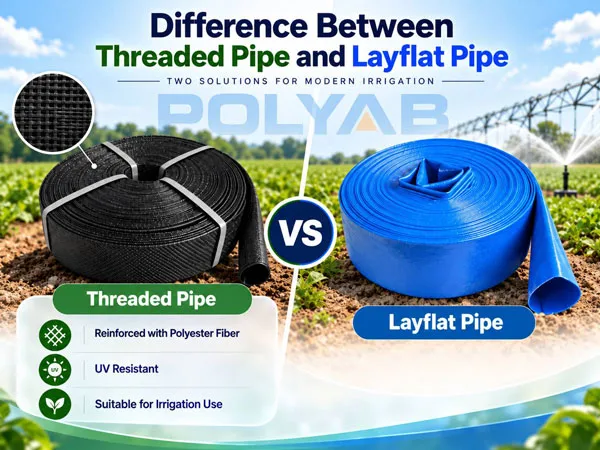
Difference Between Threaded Pipe and Layflat Pipe
A Complete Guide to Choosing the Best Pipe for Agricultural Irrigation
In agricultural irrigation systems, choosing the right pipe is one of the most important factors in reducing costs, improving water transfer efficiency, and achieving better irrigation performance. Two widely used products in this field are threaded pipe and layflat pipe. These two products may look similar in some applications, but they have important differences in structure, strength, working pressure, usage, service life, and installation method.
Many farmers, sellers, and irrigation contractors sometimes use these two terms interchangeably. However, in the professional irrigation market, understanding the difference between them helps you make a more accurate choice and avoid extra costs, pipe bursting, leakage, or pressure loss.
What Is Threaded Pipe?
Threaded pipe is a reinforced pipe or hose that contains thread, fibers, or a reinforcing layer in its structure. This threaded reinforcement helps the pipe resist pressure, stretching, tearing, and deformation.
In the irrigation industry, when people talk about threaded pipe, they usually mean agricultural threaded pipe or reinforced threaded pipe for water transfer. This product can be produced in round, flat, or semi-flat forms, and depending on its design, it can be used for water transfer in different agricultural routes.
Threaded pipe is mostly used where flexibility, strength, and surface water transfer are required.
What Is Layflat Pipe?
Layflat pipe or Layflat Hose is a flat and flexible pipe that stays flat when there is no water inside it. When water enters the pipe, it expands and works as a water transfer pipe.
The word “layflat” means that the pipe can lie flat on the ground. That is why this product is also known in some markets as flat irrigation pipe, agricultural layflat pipe, or layflat hose.
Layflat pipe is usually used for temporary water transfer routes, seasonal agricultural lands, vegetable farming, drip tape connections, and water transfer from a pump or pool to the field.
Are Threaded Pipe and Layflat Pipe the Same?
The accurate answer is: not always, but some models can have both features.
- Layflat pipe refers to the pipe’s flat shape and rollable structure.
- Threaded pipe refers to the existence of thread or fiber reinforcement inside the pipe body.
This means a pipe can be both layflat and threaded. In the market, this product is usually called:
Threaded Layflat PipeThis model is one of the most widely used products in agricultural irrigation because it is both flat and easy to collect, and because of the thread or fiber reinforcement, it has higher resistance compared to simple layflat pipes.
Main Difference Between Threaded Pipe and Layflat Pipe
The main difference between these two products is that threaded pipe refers to the reinforced body structure, while layflat pipe refers to the flat shape and easy collection of the pipe.
In simple terms:
- Threaded means the pipe has reinforcing fibers or threads.
- Layflat means the pipe becomes flat when empty and is easy to roll and collect.
So these two terms do not mean exactly the same thing, although they can be combined in some products.
Comparison Between Threaded Pipe and Layflat Pipe
| Feature | Threaded Pipe | Layflat Pipe |
|---|---|---|
| Main meaning | Pipe reinforced with thread or fibers | Flat and rollable pipe |
| Product name focus | Body structure and resistance | Shape and collection method |
| Appearance | Can be round, flat, or semi-flat | Usually flat when empty |
| Strength | High, depending on thread and reinforcement layer | Different depending on material and model |
| Easy collection | Depends on the model | Very easy |
| Main application | Stronger water transfer and agricultural routes | Temporary and seasonal water transfer |
| Suitable for drip tape | Yes, in agricultural models | Yes, especially threaded layflat models |
| Installation | Relatively easy | Very fast and easy |
| Common use | Irrigation, water transfer, agricultural systems | Seasonal irrigation, vegetable farming, rented lands |
| Best agricultural model | Agricultural threaded pipe or threaded layflat pipe | Reinforced threaded layflat pipe |
Applications of Threaded Pipe in Irrigation
Threaded pipe is used in irrigation for water transfer routes that require higher resistance than ordinary hoses. Depending on the product type, threaded pipe can be used for light or semi-heavy applications.
Common Applications
- Water transfer from pump to field
- Use in farm irrigation
- Connection to irrigation equipment
- Water transfer on surface routes
- Use in agriculture, orchards, and greenhouses
- Temporary and semi-fixed irrigation systems
- Water transfer in farms and vegetable fields
If the threaded pipe is a layflat type, its application in seasonal fields and drip tape connection becomes even more common.
Applications of Layflat Pipe in Irrigation
Because of its flat structure, suitable weight, and easy collection, layflat pipe is one of the best options for seasonal irrigation and row crop farming.
Common Applications
- Water transfer from pump, well, pool, or tank
- Water transfer in vegetable farms
- Connection to drip irrigation tape
- Use in rented lands
- Seasonal crop irrigation
- Fast installation of surface irrigation systems
- Easy collection after the end of the growing season
- Water transfer in temporary routes
For crops such as tomatoes, cucumbers, watermelons, melons, onions, potatoes, vegetables, and row crops, layflat pipe is one of the most widely used options.
Detailed Technical Differences
Appearance
One of the easiest ways to identify layflat pipe is its flat appearance when there is no water inside. When the pipe is empty, it lies completely flat. This makes rolling and transportation very easy.
Threaded pipe, however, is not necessarily always flat. Some threaded pipes are round, some are semi-flexible, and some are produced as layflat pipes.
Strength and Durability
Threaded pipe usually has good resistance to stretching and pressure because of its reinforcement layer. A simple layflat pipe may have lower resistance than a threaded pipe. But if the layflat pipe is threaded and reinforced, its strength becomes much better.
Installation and Collection
Layflat pipe has a major advantage in installation and collection. It can be easily laid on the ground, and after use, once the water is drained, it becomes flat and can be rolled up. Threaded pipe can also be easy to install, but if it is round or thicker, collecting it is more difficult.
Connection to Drip Tape
One of the important applications of layflat pipe in agriculture is its connection to drip tape. A hole is made on the layflat pipe with a special punch, and then the drip tape is connected using a layflat-to-tape valve.
Working Pressure
Threaded pipe can handle a reasonable amount of pressure because of its reinforcing layer. Layflat pipe is also produced in different models. Simple models are for light water transfer, while threaded models have better resistance.
Transportation
Layflat pipe is very easy to transport because it becomes flat and rolls easily. If threaded pipe is also a layflat type, transportation is easy as well. But round or thick threaded pipes take up more space.
Difference in Price
Simple layflat pipe is usually cheaper than threaded layflat pipe, but it has lower resistance. Threaded layflat pipe costs more because it is reinforced with fibers, but it gives farmers better durability and more confidence.
Which Is Better: Threaded Pipe or Layflat Pipe?
The choice between threaded pipe and layflat pipe depends on the application. If threaded pipe means a reinforced and strong product, it is suitable for better pressure resistance and durability. If layflat means a flat and easy-to-collect pipe, it is better for fast installation and seasonal use.
However, for agricultural irrigation, the best choice is usually threaded layflat pipe, because it combines the advantages of both products.
- It is flat and easy to collect.
- It is reinforced with thread or fibers.
- It has fast installation.
- It is suitable for connection to drip tape.
- It is practical for water transfer in agricultural fields.
When Is Layflat Pipe Better?
Layflat pipe is a good choice when the irrigation system is not permanent and the farmer wants to collect the pipe at the end of the season.
- Rented lands & Seasonal crops
- Vegetable & Green crop farming
- Fields with changing irrigation routes
- Temporary water transfer
- Drip tape irrigation
- Farmers who need fast installation
When Is Threaded Pipe Better?
Threaded pipe is more suitable when higher resistance, better stretching tolerance, and greater durability are important.
- Water transfer with higher resistance
- Routes where stretching may happen
- Agricultural irrigation with medium pressure
- Farms that need reinforced pipes
- Users who prefer quality over the lowest price
Common Mistakes When Buying
- Only paying attention to size or price without checking the pipe structure. (e.g., A simple 3-inch pipe is much weaker than a threaded 3-inch pipe).
- Using a weak pipe for long routes or strong pumps, leading to leakage, bursting, pressure loss, and uneven irrigation.
What Should You Consider Before Buying?
Before buying, it is better to check the following points:
- What is the pipe size in inches?
- Is the pipe simple or threaded?
- What is its working pressure and roll length?
- Will it be used for main water transfer or outlets?
- Will it be connected to drip tape or only used for water transfer?
- Is the land seasonal or permanent?
- Should the pipe be collected at the end of the season or stay fixed?
- What is the quality of the raw material and sunlight resistance?
Conclusion
In conclusion, threaded pipe and layflat pipe do not mean exactly the same thing. Threaded pipe refers to a pipe reinforced with thread or fibers, while layflat pipe refers to a pipe that becomes flat and is easy to collect.
If a pipe is both flat when empty and reinforced with thread or fibers, it is called threaded layflat pipe, which is one of the best options for agricultural irrigation.
In simple terms:
- Threaded pipe means a pipe reinforced with thread or fibers.
- Layflat pipe means a flat and easy-to-collect pipe.
- Threaded layflat pipe means a combination of both features; suitable for water transfer, seasonal irrigation, and drip tape connection.
Polyab Irrigation Products Under the Fonte Vita Brand
Polyab, under the Fonte Vita brand, supplies agricultural irrigation products including side-seam drip irrigation tape, agricultural threaded pipe, threaded layflat pipe, and polyethylene irrigation pipe. These products are designed for farms, greenhouses, orchards, and modern irrigation systems, and they can provide a reliable solution for water transfer and water distribution in agriculture.